

Congratulations to Dr. Jeanine Davis and her staff on their article in The Southeast Farm Press, Demand, Interest in Hops Soaring In North Carolina.
Roy Roberson
January 7, 2013
rroberson@farmpress.com
Three large beer brewers are building
their east coast breweries in North Carolina, combined with 60 or so
craft beer brewers and a thriving number of amateur brewers and there
has grown a significant demand for one of beer’s primary ingredients —
hops.
The crop is not native to the Tar Heel state, but has been grown in the
past and can be grown now, but just how to do that has proven to be a
perplexing challenge for North Carolina State University Horticulturist
Jeanine Davis.
Davis and her research team at North Carolina State’s Mountain
Horticultural Research Station in Mills River, N.C., and on the main
campus in Raleigh, have taken up the challenge and are making progress
in getting hops planted in the western and piedmont sections of North
Carolina.
With the financial help of the North Carolina Golden Leaf
Foundation, North Carolina State University soil scientists Rob Austin
and Scott King, established a short trellis hop yard, which is the
terminology used for a planting of hops, at the Lake Wheeler Road Field
Laboratory in Raleigh, N.C in 2010.
The experimental hop yard includes 200
total hops plants on one-quarter of an acre. The hop yard contains 10
different U.S. hops varieties replicated four times throughout the
experimental site.
The varieties were selected based on their range of alpha
acid content (bitterness), yield potential, disease and pest resistance,
total U.S. production, and demand by local craft breweries.
In 2011, with financial help from a
Specialty Crops Block Grant through the North Carolina Department of
Agriculture, Davis established a quarter acre high trellis (20 feet
tall) hop yard at the Mountain Horticultural Crops Research Station. It
has 10 varieties, eight of them the same as in the Raleigh yard.
Austin, King, and Davis have worked the
past three years with a small community of growers with established hop
yards in western North Carolina.
Sierra Nevada, a nationally known brewery
with some quirkily named, but highly popular beers, recently began
construction of a brewery adjacent to the Mountain Horticultural Crops
Research Station in Mills River. “We considered building a zip line
across the river direct to the brewery,” Davis jokes.
When asked why they chose to move to
the mountains of western North Carolina, a Sierra Nevada spokesperson
says, “We were charmed by the people and environment in Asheville. We
love the sense of the outdoors and connection to the land, as well as
the amazing beer culture and brewing scene that’s sprung up over the
past decade.”
Currently, New Belgium and Oskar Blues breweries are in the
process of establishing breweries in North Carolina.
New Belgium, which markets the highly
successful Fat tire brand beer, plans to break ground for it $175
million facility in the first quarter of 2013 and plans to begin brewing
beer there by early 2015.
Oskar Blues will actually be the first of three
breweries to begin operation from their plant in Brevard, N.C.
In addition to national craft brewers,
like Sierra Nevada and New Belgium, a number of local craft brewers, or
micro brewers have been highly successful in western North Carolina,
especially in and around Asheville.
“And, making home beer has become such a
big hobby that there are now competitions, much like chili cook-offs”,
Davis says.
Growing hops in the cool mountain air of western North Carolina
may seem like a natural, because of the similarity with areas in
southern Germany, in which hops production is done on a large scale.
However, in reality, most of the old world hops varieties grown in
Europe aren’t well suited at all for production in the Upper Southeast.
Though Germany, in particular Bavaria, is
the largest hops producer in the world, with about 35 percent of
worldwide hops production, the U.S. is rapidly gaining, producing about
24 percent of global output.
In the U.S., hops production is highly
concentrated in Idaho, Washington and Oregon. Davis notes that hops
grows best between the 35th and 55th latitude, considerably farther north than North Carolina.
Even the Pacific Northwest, at the bottom
end of the ideal crops production area, growers can count on 16 or more
hours of daylight during peak hops growing season. In western North
Carolina, maximum daylight is about 14 hours.
This is critical because hops is a highly
day-length sensitive crop. Davis points out there are now some hops
varieties that are more daylight neutral and require less daylight than
varieties grown in most areas of the world.
“These day-length neutral varieties, bred
in South Africa, are the ones we need to use in North Carolina, she
says.
“Brewers will likely ask for more commonly known aromatic hops, but any
new grower should grow hops varieties suited for production in North
Carolina, and then convince the brewer to use these varieties,” she
adds.
“There are some indications that growing day-length sensitive varieties
here in North Carolina is severely limiting our yields. In some cases,
we may be losing up to 85 percent of potential yield, just because we
are trying to grow the wrong varieties”.
She points out the obvious — all these
new craft brewers coming into North Carolina want locally grown hops.
“We know there is demand for locally grown hops, but so far I don’t know
of any local growers who have found a way to grow hops on a large scale
and do so profitably,” she adds.
“We’re working on it, but so far the hops
industry in North Carolina is definitely in its infancy”.
Labor is definitely a limiting factor in
establishing commercial size hop yards. Right now all the hops grown in
North Carolina are hand harvested. It takes about an hour to
hand-harvest a pound of wet hops, which sells to local micro or craft
brewers for $16-$20 per pound. Dried hops sells to home brewers for
$3-&5 per ounce.
To be profitable, the research indicates that commercial
growers need to harvest at least one pound of wet hops per plant and
sell those for about $20 per pound.
To brew a small batch of a seasonal beer
with wet hops, most breweries need 25 to 30 pounds of hops. This is an
attainable goal, but so far, none of the growers are reporting making a
profit.
The cost of establishing a hop yard is high, somewhere between
$12,000 and $16,000 per acre, perhaps somewhat less if a grower has free
access to tall, sturdy locust poles needed in the construction process.
When selecting a hops site, growers should pay special attention to three things, Davis says:
• Select fertile, well drained soils;
• Select a site with good air circulation;
• Select a site with good overall drainage.
Hops is a perennial plant that is usually
grown from spring transplanted rhizome pieces. It grows and fruits best
when it grows vertically, hence the need for tall, sturdy poles as part
of the hops yard. As the hops yard matures, production typically goes
up and production costs come down.
The over-riding key to have any chance at
making a hops yard profitable is to choose varieties that are best
suited to your growing conditions, the North Carolina State specialist
says.
“Hops are typically grown from rhizome pieces, and it is critical to
get clean, healthy rhizomes for transplanting, she adds.
The North Carolina specialist says not
keeping the sprouts pruned back long enough in the spring is probably
limiting production. “Waiting until April to let these sprouts grow
seemed to work best for growers this year,” she says. Research continues
to uncover production tips and these are passed along via myriad
conventional Extension channels and not-so-conventional social media
outlets.
So far, so good with the few hops growers trying it on a small
scale, Davis says. “Hops are doing surprisingly well here, considering
how far south we are located! They seem to be doing particularly well in
the mountain areas, she says.
“Our hops mature really early here; we start
harvesting in July. We aren’t sure what that means for the plants in the
long-term. We have more disease, insect, and weed pressure than in the
Pacific Northwest, but we expected that and we are figuring out ways to
cope.
“I think our success will rely on having markets that will pay a
premium for high quality, locally grown, hand-harvested hops,” she adds.
Showing posts with label hops. Show all posts
Showing posts with label hops. Show all posts
Tuesday, January 8, 2013


Tuesday, July 3, 2012
This Thursday: Research Hop Yard “Open House”
Event: Research Hop Yard “Open House”

Date of Event: July 5, 2012
Time of Event: 5:00 PM to 7:00 PM
Location of Event: Mountain Horticultural Crops Research Station, 74 Research Drive, Mills River, NC 28759.

Description:
Last
year we established a high-trellis research hop yard to help the new
hop industry developing in western North Carolina. There are ten
popular varieties planted in a replicated trial. The trellis system
demonstrates two methods for lowering the top wire so the use of ladders
or cherry pickers for stringing, maintenance, and harvest is not
necessary. There is a drip-irrigation system and a landscape fabric
mulch weed control system. This is not a full-fledged field day this
year with speakers and a set agenda. This is a casual “drop-in” event
and an opportunity for hop growers and potential hop growers to view the
ten varieties before we start harvesting and talk with the researchers,
Jeanine Davis and Kelly Gaskill. The differences between the varieties
are pretty dramatic this year. We have experienced Downy Mildew, spider
mites, and now Japanese beetles and we will tell you what steps we have
taken to control them. We’d love for you to share your experiences,
too.
Directions:
From
Interstate 26, take Exit #40 (the Asheville Regional Airport exit). At
the top of the exit ramp take NC Hwy 280 South (go towards the airport).
Drive past the airport and take the first road on the right, Old
Fanning Bridge Road (just after the big curve to the right and marked by
a green and white sign for the Mountain Horticultural Crops Research
and Extension Center. After about one mile you will cross the French
Broad river. The research station is on the right but directly across
the street from the entrance to the research station there will be signs
directing you left onto Butler Farm Road. Follow the signs out to the
hop yard.
This
project is funded by a USDA Specialty Crops Block Grant administered
through the NC Department of Agriculture and Consumer Services. The
project is in the NC Alternative Crops and Organics Program of Dr.
Jeanine Davis, Associate Professor and Extension Specialist, Department
of Horticultural Science, NC State University, Mountain Horticultural
Crops Research and Extension Center, 455 Research Drive, Mills River, NC
28759. More information on her program and the companion Hops Field
Day being held in Raleigh can be found at http://Monday, December 5, 2011
NC Hops Update: NC Alternatives Crops Blog
Check out Dr. Jeanine Davis's latest post on the NC Hops project: Hops in North Carolin and New York
Wednesday, October 19, 2011
Webinars: Marketing Organic Produce, Transplants, Food Safety and Hops Production
Join eOrganic and Michigan SARE for a series of 4 free webinars on marketing organic produce, organic transplants, food safety, and hops production in October and November! All webinars are open to the public, and advance registration is required.
Save the dates and register now at for the following webinars at http://www.extension.org/
Plan for Marketing Your Organic Products, by Susan Smalley, Michigan State University: October 25, 2011 at 2PM Eastern Time. Register at http://www.extension.org/
Root Media and Fertility for Organic Transplants, by John Biernbaum, Michigan State University: November 1, 2011 at 2PM Eastern Time. Register at http://www.extension.org/
Tracking Your Produce—For Your Business and Health, by Colleen Collier Bess, Michigan Department of Agriculture and Natural Resources: November 8, 2011 at 2PM Eastern Time. Register at http://www.extension.org/
Starting Up Small-Scale Organic Hops Production, Rob Sirrine, Michigan State University and Brian Tennis, Michigan Hop Alliance: November 15, 2011 at 2PM Eastern Time. Register at http://www.extension.org/
Find the updated eOrganic webinar schedule and listen to recordings of past presentations at http://www.extension.org/
Tuesday, September 20, 2011
SARE Report: Breaking into Organic Hops with Blue Ridge Hops
Check out the report below on local, organic hops producers Rita and John from Blue Ridge Hops in Madison County. In 2009 the couple received a Southern Sustainable Agriculture Research and Education (SARE) grant to help them with their 1/2 acre hops yard.
Breaking into Organic Hops Production
To learn more about Southern SARE grants click here.
Breaking into Organic Hops Production
To learn more about Southern SARE grants click here.
Thursday, September 15, 2011
Local Grower is WLOS Person of the Week
Van Burnette, of Hop'n Blueberry Farm in Black Mountain was the WLOS person of the week last week. Van grows hops, blueberries and medicinal herbs in addition to having a butterfly flight house and milkweed nursery.
Van is also a blogger for his blog Hop'n Blueberry Farm News. In this post he blogs about the experience of being interviewed for this segment.
In addition to be an innovative farmer, Van is a great person and a wonderful friend to the NC Cooperative Extension Service. Way to go, Van!
Check out Van and Buncombe County Small Farms Agent, Melinda Roberts in the Person of the Week Segment below.
Asheville. NC :: Person of the Week - Van Burnette
Van is also a blogger for his blog Hop'n Blueberry Farm News. In this post he blogs about the experience of being interviewed for this segment.
In addition to be an innovative farmer, Van is a great person and a wonderful friend to the NC Cooperative Extension Service. Way to go, Van!
Check out Van and Buncombe County Small Farms Agent, Melinda Roberts in the Person of the Week Segment below.
Asheville. NC :: Person of the Week - Van Burnette
Tuesday, November 9, 2010
Organic Hops Growers Score Big!
Here is some exciting news for organic hops producers from the American Hop Grower Association webpage:
"The organic hop industry scored a big win on October 28, 2010 when the National Organic Standards Board (NOSB) unanimously voted in favor of removing hops from the USDA National Organic Program’s National List of Approved and Prohibited Substances (section 205.606), effective January 1, 2013. Since hops were added to the National List in 2007, the production of organic hops in the U.S. has increased substantially...."
To read the entire article click here.
You may remember my post a few weeks ago entitled:"Should Organic Beers Contain Organic Hops?". I guess the National Organic Program Standards Board believes they should!
"The organic hop industry scored a big win on October 28, 2010 when the National Organic Standards Board (NOSB) unanimously voted in favor of removing hops from the USDA National Organic Program’s National List of Approved and Prohibited Substances (section 205.606), effective January 1, 2013. Since hops were added to the National List in 2007, the production of organic hops in the U.S. has increased substantially...."
To read the entire article click here.
You may remember my post a few weeks ago entitled:"Should Organic Beers Contain Organic Hops?". I guess the National Organic Program Standards Board believes they should!
Tuesday, October 19, 2010
NC Hops Project Has a New Website!
Check out Dr. Jeanine Davis's blogpost on the NC Alternative Crops and Organics Blog about the new NC Hops Project website.
This will undoubtedly be a great resource for individuals considering hops production in NC.
Check out the new website directly at http://nchops.soil.ncsu.edu/.
This will undoubtedly be a great resource for individuals considering hops production in NC.
Check out the new website directly at http://nchops.soil.ncsu.edu/.
Monday, October 18, 2010
Should Organic Beers Contain Organic Hops?

Here is an article from the Yakima Herald-Republic via the Kitsap Sun website that was forwarded to me about the struggle for organic hops producers in the Pacific-Northwest to sell their crop.
For Organic Hops Farmers in Washington, Gov. Obstacles
The difficulty lies in the National Organic Program exemptions for some non-organic ingredients that are allowed in organic products.
I'd like to hear what you think about these exemptions. Use the the comments function below.
Thursday, July 29, 2010
2nd Annual WNC Hops Farm Tour Saturday!

The 2nd Annual WNC Hops Tour is this Saturday, July 31st!
We had such a fun time last year, we decided to do it again!
This year we will visit Winding River Hops in Clyde, NC in Haywood County. You may remember this farm from when I did some hops stringing this spring. After Winding River Hops we will travel to Black Mountain to visit Hop'n Blueberry Farm. Both of these growers are WNC AgOptions grant recipients.
There is a lot to see this year, the hops yards look great and some of your favorite local breweries are making beer from the local hops!
After the tour at Hop'n Blueberry Farm, we will travel to French Broad Brewing Company for a special tour and tasting.
Here are the details:
When?: Saturday, July 31. Registration starts at 8 am. Tour begins at 9 am.
Where?: Winding River Hops Farm, 3949 Thickety Rd in Clyde, NC. Parking at Oak Grove Baptist Church. Signs will be posted. Download the tour flyer for complete directions.
How much?: $10 per carload. CASH ONLY.
Who should attend?: Folks interested in growing hops, commercial and home brewers and beer and hops enthusiasts.
What else?: Specialists from NC State University and NCDA & CS including Dr. Jeanine Davis, Dr. Hannah Burrack, Mr. Rob Austin and Mr. Bill Yarborough will be on hand to discuss current hops projects and research. Chris Reedy and other grower members of the Southern Appalachain Hops Guild will also be at the tour discussing this year's crop and the work they are doing.
For more details download the tour flyer.
I hope to see you there!
Thursday, May 20, 2010
Downy Mildew on Hops Present in WNC

This week I have been visiting with our WNC hops growers. To my dismay, I found the dreaded downy mildew, Pseduoperonospora humuli, in two of the yards.
We saw the beginnings of this problem late last season on the hop cones. See my post from September 2008 on downy mildew of hops.
When determining if you have downy mildew in your hops yard, look for pale green to yellow newly emerged spikes that appear stunted.
 Note the pale green, stunted spikes of this hops plant.
 A closer look at the pale green to yellow new spike. Note the shorten internodes and miniature leaves.
 Another shot of the infected, newly emerged shoot. Take note of the curled and brown lower leaves.
 A close up of the browning, curled leaves on the hops shoot. The leaf looks dirty, but those are actually millions of downy mildew sporangia!
 A hops leaf exhibiting foliar symptoms of downy mildew.
 The underside of the downy mildew infected leaf. Note the fuzzy spores.
The worst downy mildew infection that I noted was on 'Nugget'. 'Nugget' is considered to be susceptible to downy mildew. Interestingly, in the hops yard where downy mildew was found on 'Nugget', it appeared to be the most vigorous variety.
**Update May 21**
Some sources report that 'Nugget' is resistant to downy mildew, while others report it is susceptible.
Downy mildew was also found to be prevalent on 'Centennial' which is considered to be tolerant to downy mildew.
One of the best management strategies for the control of downy mildew on hops is to remove primary basal spikes and to heavily prune and strip leaves. This is important in order to prevent downy mildew from moving up the bines and eventually infecting the cones. Pruning and thinning also helps to reduce moisture and humidity in the lower part of the canopy which is favorable for disease development.
**Update May 21**
Some sources report that 'Nugget' is resistant to downy mildew, while others report it is susceptible.
Downy mildew was also found to be prevalent on 'Centennial' which is considered to be tolerant to downy mildew.
One of the best management strategies for the control of downy mildew on hops is to remove primary basal spikes and to heavily prune and strip leaves. This is important in order to prevent downy mildew from moving up the bines and eventually infecting the cones. Pruning and thinning also helps to reduce moisture and humidity in the lower part of the canopy which is favorable for disease development.
 Hops yard with lower leaves stripped up to 3 feet.
Because we are expecting wet weather in the next few days here in WNC, action needs to be taken quickly to prevent the spread of disease to other bines. The first step is to prune and thin the bines.
In addition, the application of fungicides is recommended as soon as the wet weather is over or before if product is rainfast. For a complete list of fungicides (conventional and organic) used to control downy mildew on hops, visit the Oregon State University Downy Mildew Fact Sheet. Before you apply any pesticide make sure you follow the specific label directions and make sure that the product is labeled for downy mildew on hops in NC.
*UPDATE*
Organic Fungicides Labeled for Management of Downy Mildew of Hops in NC:
- Sporatec (rosemary oil, clove oil and thyme oil)
- Copper products (look for OMRI label)
- Sonata (Bacillus pumulis strain QST 2808)
Conventional Fungicides Labeled for Management of Downy Mildew of Hops in NC (not a complete list):
- Curzate (cymoxanil) - must be tank mixed with a fungicide of different mode of action, such as copper
- Tanos (cymoxanil + famoxadone) - must be tank mixed with a fungicide of different mode of action, such as copper
- Acrobat and Forum (dimethomorph) - must be tank mixed with a fungicide of different mode of action
- Fosphite and other phosphorous acid products
- Legion (Aluminum tris)
The best approach would be to incorporate a few of these products in order to slow down the possibility of fungicide resistance. Again, always follow the directions on the label - it's the law!
Hops Pest: Eastern Comma Butterfly
A few weeks ago a number of our local hops producers were noticing large holes in some of their hops leaves. Upon closer inspection, they found spiky, white caterpillars feeding on the leaves.
 Larva of Eastern comma butterfly found on hops in WNC (picture courtesy of R. Pelczar).
The entomologists at NCSU agreed that the caterpillars are larvae of the Eastern comma butterfly, Polygonia comma.
 Larva of Eastern comma butterfly found on hops in WNC (picture courtesy of R. Pelczar).
Hosts:
Hosts plants of the Eastern comma butterfly are American elms, hackberry, nettles, false nettles and other members of the Urticacea. But, perhaps the favorite food of the Eastern comma butterfly is hops.
Beginning in the early 1900's, the Eastern comma butterfly was referred to as the "hop merchant" because hops farmers would predict the future price of hops based on the variation in the silver and gold spots on the pupae.
Larvae:
The larvae ranges in color from white to green-brown to black and are typically just over 1 inch long. The spikes also range in color from black to white with black tips. The larvae rest on the underside of leaves and make nests by silking together the sides of the leaf. The larvae rest during the day and feed at night.
 Eastern comma butterfly larva. (Picture courtesy of Echoview Farm).
Eggs:
The eggs are green with vertical ridges and are laid singly or in stacks. I was lucky to find these (sorry they are not the greatest pics)!
 Eggs of Eastern comma butterfly on underside of hops leaf.
 Close-up of the eggs of Eastern comma butterfly. Notice the vertical ridges.
Pupae:
Pupae are variable in color but always have prominent ventral gold or silver spots.
Adults:
The adult is an orange and brown butterfly with a wingspan of 1.75 to 2 inches. With its wings folded it looks like a dead leaf.
Life Cycle:
There are two generations per year for Eastern comma butterflies. During the summer, the new butterflies are inactive during the hot period and then become active again in the fall. The fall brood of adult butterflies overwinter and start the cycle again in the spring.
Management:
The feeding damage caused by the Eastern comma butterfly larvae ranged in the individual hops yards here in WNC. One grower experienced quite a bit of initial damage, but was able to prevent further destruction by hand-picking the caterpillars.
Growers at another farm reported shaking the bines to knock off the caterpillars and then destroying them. This appeared to work well and little damage has since been noted. This grower also applied BT (Bacillus thuringiensis, a bacterial biological control material that is labeled for Lepidopteran pests) and reported that it was effective.
Hopefully, the Eastern comma butterfly will not be a problem for our hops growers in the future. At least now we know what the pest is and how to control it.
Thanks to all the folks who helped in the identification of the larvae and for the great growers for sharing their experience and their wonderful pictures!
To learn more, read the University of Florida's fact sheet on the Eastern Comma Butterfly.
 Larva of Eastern comma butterfly found on hops in WNC (picture courtesy of R. Pelczar).
 Larva of Eastern comma butterfly found on hops in WNC (picture courtesy of R. Pelczar).
Hosts:
Hosts plants of the Eastern comma butterfly are American elms, hackberry, nettles, false nettles and other members of the Urticacea. But, perhaps the favorite food of the Eastern comma butterfly is hops.
Beginning in the early 1900's, the Eastern comma butterfly was referred to as the "hop merchant" because hops farmers would predict the future price of hops based on the variation in the silver and gold spots on the pupae.
Larvae:
The larvae ranges in color from white to green-brown to black and are typically just over 1 inch long. The spikes also range in color from black to white with black tips. The larvae rest on the underside of leaves and make nests by silking together the sides of the leaf. The larvae rest during the day and feed at night.
 Eastern comma butterfly larva. (Picture courtesy of Echoview Farm).
Eggs:
The eggs are green with vertical ridges and are laid singly or in stacks. I was lucky to find these (sorry they are not the greatest pics)!
 Eggs of Eastern comma butterfly on underside of hops leaf.
 Close-up of the eggs of Eastern comma butterfly. Notice the vertical ridges.
Pupae:
Pupae are variable in color but always have prominent ventral gold or silver spots.
Adults:
The adult is an orange and brown butterfly with a wingspan of 1.75 to 2 inches. With its wings folded it looks like a dead leaf.
Life Cycle:
There are two generations per year for Eastern comma butterflies. During the summer, the new butterflies are inactive during the hot period and then become active again in the fall. The fall brood of adult butterflies overwinter and start the cycle again in the spring.
Management:
The feeding damage caused by the Eastern comma butterfly larvae ranged in the individual hops yards here in WNC. One grower experienced quite a bit of initial damage, but was able to prevent further destruction by hand-picking the caterpillars.
Growers at another farm reported shaking the bines to knock off the caterpillars and then destroying them. This appeared to work well and little damage has since been noted. This grower also applied BT (Bacillus thuringiensis, a bacterial biological control material that is labeled for Lepidopteran pests) and reported that it was effective.
Hopefully, the Eastern comma butterfly will not be a problem for our hops growers in the future. At least now we know what the pest is and how to control it.
Thanks to all the folks who helped in the identification of the larvae and for the great growers for sharing their experience and their wonderful pictures!
To learn more, read the University of Florida's fact sheet on the Eastern Comma Butterfly.
Sunday, May 16, 2010
Local Hops Producers Featured in Raleigh N&O
Congratulations to two of our local WNC hops producers, Julie Jensen and Van Burnette, who were featured in the Raleigh News & Observer Story "Brewers Have High Hopes for NC Hops".
In addition, we have a lot to be thankful for with all the hard work that NCSU researchers, Dr. Jeanine Davis, Dr. Deanna Osmond and Rob Austin are doing to help our hops industry grow!
Congratulations everyone!
Here is a sidebar from the on-line article entitled, "Beer in the Mountains":
In addition, we have a lot to be thankful for with all the hard work that NCSU researchers, Dr. Jeanine Davis, Dr. Deanna Osmond and Rob Austin are doing to help our hops industry grow!
Congratulations everyone!
Here is a sidebar from the on-line article entitled, "Beer in the Mountains":
The four farms working with N.C. State University to explore the possibility of commercial hops growing are all clustered around Asheville, and that's no coincidence: The mountain city is gaining national attention as an attraction for craft-beer lovers, and would be an obvious market for the bitter flowers.
Last year Asheville was voted "Beer City USA" in an online poll, sharing the top honor with a much better-known brewing city, Portland, Ore.
Also in 2009, eight brewing operations in the city and four nearby formed the Asheville Brewers Alliance.
"Any day of the week, you can have your choice of probably 80 Asheville-made beers," said Tony Kiss, who covers beer like a sport for the Asheville Citizen-Times.
A tour called the Brews Cruise takes tourists on a circuit of local brewing operations and the city now boasts five annual beer festivals. All 3,500 tickets for the fall Brewgrass Festival were snapped up in less than a day when they went on sale Wednesday.
With all this beer action, Black Mountain farmer Van Burnette said hops growers like him not only could supply local brewers with their most crucial ingredient, but also could become part of a critical mass of attractions for the beer-related tourism.
Thursday, April 22, 2010
New Hops Page!
Everyday Blogger gets more and more sophisticated! This year Blogger has decided to allow bloggers to create different pages to their sites.
Today I am launching the new Hops Page on WNC Vegetable and Small Fruits News blog. This page will be maintained as a one-stop-shop for information on hops production, diseases and insects, pictures and other resources.
The new Hops Page can be found just above the "Exciting Stuff!!!" section on the left-hand side bar of the blog.
This is a work in progress and will be updated with new information as I post about hops or find exciting resources. I also welcome comments, suggestions or other information that you find important to include on the new page.
Let me know what you think!
Today I am launching the new Hops Page on WNC Vegetable and Small Fruits News blog. This page will be maintained as a one-stop-shop for information on hops production, diseases and insects, pictures and other resources.
The new Hops Page can be found just above the "Exciting Stuff!!!" section on the left-hand side bar of the blog.
This is a work in progress and will be updated with new information as I post about hops or find exciting resources. I also welcome comments, suggestions or other information that you find important to include on the new page.
Let me know what you think!
Wednesday, April 14, 2010
Hops Season Has Begun!
Saturday was a beautiful day! The weather was perfect for some work on the farm. I decided to volunteer at a hops farm in Haywood County. Winding River Hops is run by Scott Grahl and Stephanie Willis, a pair of energetic and friendly growers who began growing hops last year. The pair received a WNC AgOptions grant in 2009 to get started.

When I arrived at the hops yard, I was pleased. The hops plants looked great and the site was virtually, weed free! Scott and Stephanie grow Sterling, Nugget and Glacier hops.
 Hops bines at Winding River Hops. Beautiful, lush, green spring growth.
Our first task was to cut string (sisal fiber twine that is biodegradable) into long segments. We did this by winding the string around two posts that were set apart by the correct number of feet. Once it was wound, it was cut and then carried to the rows.
 Stephanie and Scott carrying the strings to the hops yard.
Getting the hops tied is very important in the training of the plants. Hops require a wire to climb up - they may grow a foot per day!
Hops are a bine, a plant that has spikes and grows in a helical fashion around a wire (unlike vines, which have tendrils). This is one of the downfalls to working with hops - they are very spiny! By the end of the afternoon, my arms were all scratched up and itchy. Next time I will definitely wear long sleeves!
Look how nice a finished row looks!
 Finished hops row, all strung up!

When I arrived at the hops yard, I was pleased. The hops plants looked great and the site was virtually, weed free! Scott and Stephanie grow Sterling, Nugget and Glacier hops.
 Hops bines at Winding River Hops. Beautiful, lush, green spring growth.
Our first task was to cut string (sisal fiber twine that is biodegradable) into long segments. We did this by winding the string around two posts that were set apart by the correct number of feet. Once it was wound, it was cut and then carried to the rows.
 Stephanie and Scott carrying the strings to the hops yard.
The strings were then laid next to the rows in preparation for tying.
 Sisal fiber twine used to tie hops to the trellis system.
 Sisal fiber twine used to tie hops to the trellis system.
The next step was to tie the strings to the top wire of the trellis system. This requires carrying the strings up a ladder and tying a the string in a slipknot onto the top wire of the trelis. The ladder is a special design, crafted by a man in California specifically for hops production.
 Special hops ladder used to string and harvest hops. Not the Model ID: 1718HOP
 Special hops ladder used to string and harvest hops. Not the Model ID: 1718HOP
Stephanie had been doing the climbing until I arrived, but I decided to give it a go!
 Sue atop the hops ladder tying the string to the top wire of the trellis.
 Sue atop the hops ladder tying the string to the top wire of the trellis.
Once the strings are tied on, the rest of the crew slid them down the top wire, secured the knot onto the top wire by pulling the string, and then tied the string around the individual hops plant.
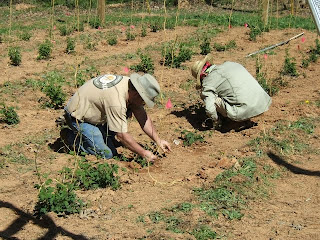 Lane and Scott tying the strings around each hops plant.
 Lane and Scott tying the strings around each hops plant.
Getting the hops tied is very important in the training of the plants. Hops require a wire to climb up - they may grow a foot per day!
Hops are a bine, a plant that has spikes and grows in a helical fashion around a wire (unlike vines, which have tendrils). This is one of the downfalls to working with hops - they are very spiny! By the end of the afternoon, my arms were all scratched up and itchy. Next time I will definitely wear long sleeves!
Look how nice a finished row looks!
 Finished hops row, all strung up!
I had a great time volunteering at Winding River Hops Farm on this beautiful Saturday! Scott and Stephanie are delightful and fun to work with! We had a great time working and chatting with one another. My reward for volunteering was, of course, a refreshing, local brew.
 French Broad Brewing Company's Gateway Kolsch. The perfect finale to a great Saturday volunteering at the hops yard!
I look forward to working more with Scott and Stephanie!
Here are some interesting sites/blogs on hops production.
Eastern Hops Guild
Hop'n Blueberry Farm News
Ocean State Hops
Growing Hops Yourself
To read previous posts on hops on WNC Vegetable and Small Fruits News, go here.
 French Broad Brewing Company's Gateway Kolsch. The perfect finale to a great Saturday volunteering at the hops yard!
Here are some interesting sites/blogs on hops production.
Eastern Hops Guild
Hop'n Blueberry Farm News
Ocean State Hops
Growing Hops Yourself
To read previous posts on hops on WNC Vegetable and Small Fruits News, go here.
Friday, March 26, 2010
Building a NC Beer Economy
 Hops is an emerging crop in NC and has great interest in WNC. Last August, NC Cooperative Extension in WNC held a tour of two hops yards in Buncombe County and in November we also held an informational meeting on hops production.
Recently, I ran across a post on Twitter that read "Building a NC Beer Economy". Of course, I had to bite and follow a link to read more about this topic. The link took me to a blog I had never heard of on fullsteam.ag . The post was about a specialist at NCSU, Rob Austin, and his interest and insight into possiblity of a hops industry in NC. To view the post and great video, visit the following link: Planting Hops at NC State
There will be another educational opportunity for folks interested in growing hops. "Hops - A Cultivation Seminar for the Perspective, Beginner and Intermediate Grower" will be held next Tuesday and Wednesday (April 6 and 7) at AB Tech, Enka Campus.
Here is a description of the class:
Learn about successful business and cultivation strategies in the developing hops industry. You will explore issues from economics to integrated pest and disease management and gain insights and resources to further your business idea. Day one topics will include Economics of the Hop Yard, Pest Management and Disease Control and Nutrient Management Programs. On day two we will provide you with a simple step-by-step guide to the seasonal processes of hop cultivation followed by the unique perspective of a local brewer addressing the industries processes, quality needs and concerns. Following the close of class there will be an optional brewery tour on Tuesday, April 7th from 3:30PM-5:00PM.
Preregistration is currently open for the class. To read more, visit the Eastern Hops Guild Blog.
I hope to see you there!
Monday, November 9, 2009
Hops Informational Meeting November 18


Come learn about the challenges and opportunities of growing hops, an exciting and new crop for Western NC!
Topics to be covered include:
- Site Selection
- Soil Fertility Requirements
- Trellising Systems
- Weed Management
- Disease and Insect Management
- Economics and Budgets
When?: Wednesday November 18 from 1—5 pm
Where?: Camp New Life at the Mountain Research Station, Waynesville, NC
How much?: Meeting fee is $5. Payment accepted at the door.
CASH ONLY!
Please RSVP to the Haywood County Extension Office:
Phone: 828-456-3575 or E-mail: erin_freeman@ncsu.edu or tim_mathews@ncsu.edu
Wednesday, September 23, 2009
Downy Mildew: Hops
Hops are a new crop to western North Carolina. As with all new crops, it is going to take some time to figure the ins and outs of hops production. We are learning from our current hops growers about when and how to harvest, yield per bine, how to dry the hops cones, what varieties work well for WNC and how to control mites, leafhoppers and other pests.
In addition, as you all know, WNC is very humid and sometimes wet! As a result, we struggle with the control of plant diseases. Hops are no exception. Upon my last visit to the hops yard, I found some leaves exhibiting symptoms that had me concerned. I had discovered what I initially thought was downy mildew, caused by the fungal-like organism, Pseudoperonospora humuli, on some lower hops leaves.
 Downy mildew causes angular lesions, bound by leaf veins.
Note: the large circular lesion is not caused by downy mildew
 Underside of leaf infected by P. humuli
 Underside of leaf infected by P. humuli
Upon inspection using my hand lens, I was able to confirm that there was downy mildew sporangia emerging on the underside of the leaf surface. Because I love learning about plant diseases, I had to take a closer look using a dissecting microscope (about 20-45x magnification).
 The fuzzy growth of P. humuli on the underside of the leaf surface.
 Sporangia (spores) and sporangiophores of P. humuli on underside of hops leaf.
 Sporangia (spores) and sporangiophores of P. humuli on underside of hops leaf. You can really see the football/lemon shaped spores at this magnification.
In addition, as you all know, WNC is very humid and sometimes wet! As a result, we struggle with the control of plant diseases. Hops are no exception. Upon my last visit to the hops yard, I found some leaves exhibiting symptoms that had me concerned. I had discovered what I initially thought was downy mildew, caused by the fungal-like organism, Pseudoperonospora humuli, on some lower hops leaves.
 Downy mildew causes angular lesions, bound by leaf veins.
Note: the large circular lesion is not caused by downy mildew
 Underside of leaf infected by P. humuli
 Underside of leaf infected by P. humuli
Upon inspection using my hand lens, I was able to confirm that there was downy mildew sporangia emerging on the underside of the leaf surface. Because I love learning about plant diseases, I had to take a closer look using a dissecting microscope (about 20-45x magnification).
 The fuzzy growth of P. humuli on the underside of the leaf surface.
 Sporangia (spores) and sporangiophores of P. humuli on underside of hops leaf.
 Sporangia (spores) and sporangiophores of P. humuli on underside of hops leaf. You can really see the football/lemon shaped spores at this magnification.
After the dissecting microscope, I had to take a closer look at the sporangia and sporangiophores using the light microscope. Check out these beautiful pictures of P. humuli up close and personal (200-600x magnification)!
 Football/lemon shaped sporangia and dichotomously branched sporangiophores (note the pointy ends upon which the sporangia are borne).
 Another picture of the sporangia and sponrangiophores of P. humuli.
 P. humuli sporangia. Note the small raised bump at one end of the sporangia. This is the papilla and is characteristic and diagnostic of this pathogen.
Strategies for the Management of Hops Downy Mildew
To manage downy mildew of hops it will take an integrative approach using some or all of the following strategies.
I would like to thank Dr. Kelly Ivors and Landis and Dreama for letting me use their awesome microscopes and camera to take these incredible pictures!!
 Football/lemon shaped sporangia and dichotomously branched sporangiophores (note the pointy ends upon which the sporangia are borne).
 Another picture of the sporangia and sponrangiophores of P. humuli.
 P. humuli sporangia. Note the small raised bump at one end of the sporangia. This is the papilla and is characteristic and diagnostic of this pathogen.
Strategies for the Management of Hops Downy Mildew
To manage downy mildew of hops it will take an integrative approach using some or all of the following strategies.
- Host Resistance. One of the most effective management strategies for hops downy mildew is to plant resistant varieties. There is no variety that is immune to downy mildew, but 'Fuggle', 'Cascade', 'Newport' and 'US Tettnang' are resistant. 'Centennial', 'Willamette', 'Chinook', 'Liberty', 'Cascade', 'Bullion' and 'Brewer's Gold' are tolerant. 'Late Cluster', 'Galena', 'Horizon' and 'Nugget' are susceptible. Interestingly, many of the varieties that are resistant to downy mildew are susceptible to powdery mildew and vice versa. For a complete listing of varieties inlcuding disease susceptibility, pedigree and chemical characteristic, see the Compendium of Hop Diseases and Pests edited by Walter Mahaffee, Sarah Pethybridge and David Gent. This book is a must have for a hops producer!
- Disease Free Stock. It is always important to purchase disease free plant stock! Ask your supplier.
- Pruning. P. humuli overwinters in dormant crowns and buds of hops. During the winter and spring, P. humuli may spread into developing buds and cause the new shoots to be systemically infected. Pruning helps to reduce downy mildew levels in already infected plantings. Pruning hops yards as late as possible in the spring can help to reduce the amount of downy mildew in the yard, however if you do it too late you may reduce yield by dealying training.
- Manage Moisture. Moisture on the leaves favors disease development, so using practices that reduce leaf moisture will also help to manage the disease. Avoid overhead irrigation.
- Reduce Inoculum. Stripping diseased leaves after training may help reduce disease in the upper plant canopy.
- Early Harvest. Early harvest may be beneficial in minimizing cone infection. Downy mildew favors the cool, wet weather that occurs late season in WNC.
- Timely Fungicide Application. Many hops growers rely on fungicide use for downy mildew control. Because P. humuli produces so many spores (progeny), it is impoprtant to employ tactics to prevent fungicide resistance. To read more about fungicides for the management of downy mildew of hops visit Oregon State Extension's Factsheet. Some organic fungicides include copper products and Sonata (Bacillus pumulis strain QST 2808).
I would like to thank Dr. Kelly Ivors and Landis and Dreama for letting me use their awesome microscopes and camera to take these incredible pictures!!
Monday, August 31, 2009
Hops Tour a Success!

Over 100 people attended the first ever Hops Farm and Brewery Tour on Saturday coordinated by the NC Cooperative Extension Service. Small farms agent, Melinda Roberts, organized the event which consisted of a two farm tour at Landfair Farm and Hop'n Blueberry Farm and a tour of a local microbrewery, Pisgah Brewing Company.
The day started at Landfair Farms, where Julie Jenson and her tireless crew cultivate approximately 1,300 hops bines. The hops varieties they grow include, Cascade, Willamete, Brewers Gold and others.

The crowd came eager to learn, despite the early threat of rain.
 Dr. Jeanine Davis (read more about the tour on her new blog!) discussed the efforts she has been taking to advance our knowledge of hops production in WNC. Dr. Davis also discussed that with new crops we have a lot to learn and a lot of challenges to face- but that is what makes hops fun and exciting. She also stressed that it is important that growers communicate with one another and take notes because we have a lot to learn.
The crowd listened attentively.
 Next Chris Reedy, local beer and hops enthusiast, discussed his efforts to start a guild for hops growers. After the tour Chris founded the Eastern Hops Guild. This will be just the type of organization that Dr. Davis discussed. A group of individuals with the common goal to forward the hops industry here in WNC.
Next, Julie Jenson, the proprietor of Landfair Farms, discussed the farm. Julie explained her passion for farming and her desire to grow the hops at Landfair Farms organically. Though, she did explain that there are many challenges with growing a new crop, including lots of learning!

After the presentation, participants had time to roam through the hop yard and form connections with other interested individuals. I had a great time with the folks in this picture discussing diseases, insects and site selection. My first question is always "What beer do you like to drink?"
 Folks then enjoyed lunch at Landfair Farms. Chef in Motion provided delicious sandwiches and dessert. These folks enjoyed the food and meeting the resident pooches.
 Next, we were off to Black Mountain to Hop'n Blueberry Farm owned by Van Burnett. Van is a 2009 WNC AgOptions Grant Recipient. Van was also featured in the Black Mountain News.
Here is Van and Melinda welcoming the crowd to Hop'n Blueberry Farm!

Van, always animated, explained his hop yard and all the hard work he has put into it. Below, he explains his high tech harvesting equipment (a canvas tote bag).
 Here Van show the participants how his trellis is on a winch system so that he can lower the bines for harvesting. Despite his fears, the bines do not get entangled when he lowers them.
 Here you can see Van's hop yard and all of the people that were in attendance. Some of the varieties that Van grows include Chinook, Centennial and Nugget.
 You reap what you sow! Below is dried hops from Van's harvest. He has tried a few different methods, vacuum sealing, freezing, air drying.
Hops in the hand is worth two in the...

Finally, we were off to Pisgah Brewing Company located nearby in Black Mountain.


And we got to sample three beers 1. Endless Summer Ale 2. India Pale Ale and 3. Belgian Amber.
 Dave, the man in charge and exuberant tour guide, explained that Pisgah Brewing Company desires to remain a small microbrewery and to purchase local hops and as many local ingredients as possible. Dave also explained the brewing process and showed the participants his set-up.
Well the day had to end somewhere. This participant enjoyed the hops and brewery tour day so much, that his day ended with dancing a little jig.

It ended up being a beautiful day!
To learn more about hops production, visit the following sites:
North Carolina Specialty Crops Site
Oregon Crop Profile on Hops
Organic Hop Production
Hop Production in New England
Subscribe to:
Posts (Atom)