

This article from Fruit Growers News is a great history of the small fruit industry in the U.S.
Changing Consumer Demand Affects Small Fruit
Tim Nourse, owner of Nourse Farms in western Massachusetts- one of the largest plant suppliers- discusses how the consumer changed the small fruits landscape. In addition, Dr. Eric Hanson of the Michigan State University Horticulture Department discusses how California production of small fruit changed the industry.
Showing posts with label brambles. Show all posts
Showing posts with label brambles. Show all posts
Tuesday, October 18, 2011
Monday, July 19, 2010
Blackberry Borers Can Mean Big Problems
From the latest issue of North Carolina Pest News:
"From: Hannah Burrack, Extension Entomologist
"From: Hannah Burrack, Extension Entomologist
Blackberry Borers Can Mean Big Problems
Gina Fernandez, the North Carolina State University caneberry specialist, has just returned from sabbatical and has wasted no time getting out for field visits. Yesterday, she brought me several samples from blackberry fields in Guilford County that were in severe decline. Their problems were almost all insect related. There were more cane boring pests from these few sites than I have seen my entire time at North Carolina State University! I'd like to use these samples as an overview of the key cane boring insects in North Carolina, what symptoms to look for, and what the management strategies for these pests should entail.
Evidence of borer damage is often visible from a distance. Plants will appear weakened, and in the case of raspberry crown borer, floricanes will be loose and easily removed. There are 3 key cane boring insects in North Carolina, and these locations had all of them!
Rednecked Cane Borer
The rednecked cane borer (Agrilus ruficollis) is part of a family of beetles known as metallic wood boring beetles. The adults (http://www.ca.uky.edu/
Low levels of rednecked cane borers can be managed with cultural control, specifically by removing and destroying all infested canes during the fall. The larvae overwinter inside the cane, so pruning will remove next year's generation of adults. For large infestations, chemical control of the adults may be necessary (for chemical information, see the Southern Region Brambles IPM Guide online at http://www.smallfruits.org/
Raspberry Cane Borer
Raspberry cane borers (Oberea bimaculata), members of a family known as long horned beetles due their prominent antennae (http://www.virginiafruit.
Cultural control, via pruning, is also an effective means of managing raspberry caneborers. Insecticide treatments may be targeted to the emerging and ovipositing (egg laying) adults just after bloom in cases where large infestation exist.
Raspberry Crown Borer
Raspberry crown borer (Pennisetia marginata) is perhaps the most severe pest of caneberries in the southeast. The larvae of this clearwing moth feed on the roots and crowns of caneberry plants and can kill an entire plant. Because they spend most of their 1 to 2 year larval stage underground, they are extremely hard to manage. Work conducted in Arkansas demonstrated that late fall or early spring soil drench pesticide treatments are most effective at reducing raspberry crown borers. These timed treatments target the early instar larvae before they are ensconced in the crown.
Insecticides are, at this time, the most effective means of raspberry crown borer management. Infested plants should be completely removed, since mature larvae will not be impacted by pesticide treatments.
In addition to the damage caused by these three wood boring insects, there were also several canes with damage at the tip that were dying back.
It is possible that this damage was cause by raspberry cane borers, but no larvae were found in the canes, and what tunnels there were stopped several inches from the top. If this was raspberry cane borer injury, we would expect to see tunnels continuing to the soil level or larvae present. These canes may have been injured during tipping and then feed on be opportunistic secondary pests. I dissected one of these canes, and there was fungal growth in the gallery, although this may also be secondary.
Wood boring insects are a fact of life for caneberry growers and can easily get out of control if a planting is not management carefully. There are abundant feral and wild brambles in the landscape, which serve as hosts for all three of these insects. Carefully scouting, good cultural management, and insecticide treatment when needed will keep borers from destroying caneberry plantings.
For the latest information on insect management in small fruits in North Carolina, see the NC Small Fruit, Specialty Crop, and Tobacco IPM blog at http://ncsmallfruitsipm.
Friday, July 2, 2010
Small Fruit News July 2010
 Natchez blackberries.
The latest edition of the Southern Region Small Fruits Consortium's Small Fruit News is now on-line.
You can find it here.
In addition, have you checked out NC MarketReady's great new websites available to strawberry, blackberry and raspberry and muscadine growers?
Check them out!
Friday, May 28, 2010
Nematode Sampling in Blackberries
Blackberry production in Henderson County is really gaining ground. Currently we have about 85 acres of blackberries in production. Because this is a new crop for the area (some of our plantings will be harvesting for the first time this season) we are busy learning the ins and outs of blackberries.
Last year, Dr. Zvezdana Pesic-VanEsbroeck (I just call her Dr. Z), who is the director of the Micropropagation Unit at NCSU, came to the county to assess the presence of virus diseases on blackberries. We found virus in every one of our fields to some extent. Below I have posted some pictures of virus disease symptoms on blackberry.


There are many viruses that affect blackberries, some haven't been identified and described yet. Virologists are unsure how some of these viruses are transmitted to blackberries.
We do know that some of these viruses are spread by plant parasitic nematodes, microscopic worms that feed on plant roots. As a result, it is important to take soil samples prior to planting in order to determine levels of plant parasitic nematodes.
We are specifically concerned with a nematode known as Xiphenema, the dagger nematode. Xiphenema is known to transmit the nepoviruses, tomato ringspot virus, tobacco ringspot virus and grapevine fan leaf virus (a devastating disease in vineyards). Xipehema is also known to be a problem in newly planted apple orchards.
Last year a blackberry grower in Henderson County noticed mottled leaves and mishapen berries. Concerned that it might be a virus, he sent it to four different labs across the U.S. Each test came back with the same result, tobacco ringspot virus.
 Symptomatic leaf and blackberries caused by tobacco ringspot virus.
 Close-up of mishapen blackberry fruit caused by tobacco ringspot virus.
Concerned with dramatically reduced yields and unmarketable berries, the grower has decided to either replant the field in blackberries or to chose a different crop. The first thing we need to do to decide if blackberries should be replanted in the field was to determine the nematode levels in the soil. This is also an important step to help us determine if the virus developed in the field or came in with the plants.
So, I got my nematode/soil samling supplies together. A clean bucket, soil probe, nematode sample boxes from the NCDA&CS, quart plastic bags, a permanent marker, pen and notebook (not shown).
 Nematode sampling supplies.
 Problem field. Notice the sporadic growth and stunted plants.
 Plants in the healthy field. Notice uniform growth of the blackberries.
In taking the nematode samples, I made sure to sample both the healthy field and the problem field. I took samples from the healthy field first, making sure not to contaminate it with soil or nematodes from the problem field.
I took 20-25 soil and root cores from the beds. The samples were taken from 8-10 inches. Because Xiphenema is usually found in the root zone soil (they are migratory ectoparasites, meaning they move from root to root piercing them to feed), I took the samples as close to the plant and drip-line as possible. This required some major work getting into that dense plant canopy. I took samples throughout the planting, making sure to get a representative collection.
Next, I took 20-25 cores from the problem field. Again taking samples close to the plant and drip-line. For this site, I made sure to take the samples from symptomatic plants.
 Soil for the nematode assay. Note the nematode sample boxes from NCDA.
I am anticipating the results from the nematode test. If it comes back with levels of Xiphenema that are high, the grower has a few options.
For more details on nematode sampling, visit the NCDA&CS site.
Your local Cooperative Extension office can provide the test boxes and assistance.
Last year, Dr. Zvezdana Pesic-VanEsbroeck (I just call her Dr. Z), who is the director of the Micropropagation Unit at NCSU, came to the county to assess the presence of virus diseases on blackberries. We found virus in every one of our fields to some extent. Below I have posted some pictures of virus disease symptoms on blackberry.


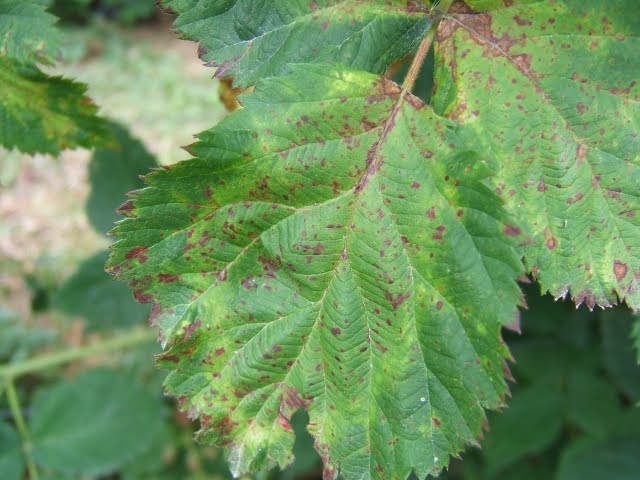
There are many viruses that affect blackberries, some haven't been identified and described yet. Virologists are unsure how some of these viruses are transmitted to blackberries.
We do know that some of these viruses are spread by plant parasitic nematodes, microscopic worms that feed on plant roots. As a result, it is important to take soil samples prior to planting in order to determine levels of plant parasitic nematodes.
We are specifically concerned with a nematode known as Xiphenema, the dagger nematode. Xiphenema is known to transmit the nepoviruses, tomato ringspot virus, tobacco ringspot virus and grapevine fan leaf virus (a devastating disease in vineyards). Xipehema is also known to be a problem in newly planted apple orchards.

Last year a blackberry grower in Henderson County noticed mottled leaves and mishapen berries. Concerned that it might be a virus, he sent it to four different labs across the U.S. Each test came back with the same result, tobacco ringspot virus.
 Symptomatic leaf and blackberries caused by tobacco ringspot virus.
 Close-up of mishapen blackberry fruit caused by tobacco ringspot virus.
Concerned with dramatically reduced yields and unmarketable berries, the grower has decided to either replant the field in blackberries or to chose a different crop. The first thing we need to do to decide if blackberries should be replanted in the field was to determine the nematode levels in the soil. This is also an important step to help us determine if the virus developed in the field or came in with the plants.
So, I got my nematode/soil samling supplies together. A clean bucket, soil probe, nematode sample boxes from the NCDA&CS, quart plastic bags, a permanent marker, pen and notebook (not shown).
 Nematode sampling supplies.
The grower has two fields, one where the virus problem has been identified and one that appears healthy. Both fields were once in apple production. The problem field is in a lower site and all the plants came from one particular nursery. The healthy field is slightly uphill from the problem field and the plants here came from another nursery. The plants in the healthy field were planted a few months later than the problem field.
 Problem field. Notice the sporadic growth and stunted plants.
 Plants in the healthy field. Notice uniform growth of the blackberries.
In taking the nematode samples, I made sure to sample both the healthy field and the problem field. I took samples from the healthy field first, making sure not to contaminate it with soil or nematodes from the problem field.
I took 20-25 soil and root cores from the beds. The samples were taken from 8-10 inches. Because Xiphenema is usually found in the root zone soil (they are migratory ectoparasites, meaning they move from root to root piercing them to feed), I took the samples as close to the plant and drip-line as possible. This required some major work getting into that dense plant canopy. I took samples throughout the planting, making sure to get a representative collection.
Next, I took 20-25 cores from the problem field. Again taking samples close to the plant and drip-line. For this site, I made sure to take the samples from symptomatic plants.
 Soil for the nematode assay. Note the nematode sample boxes from NCDA.
I am anticipating the results from the nematode test. If it comes back with levels of Xiphenema that are high, the grower has a few options.
- Plant a different crop in this site for a few years (Xiphenema reproduces once per year and can live four to five years) before replanting in blackberries. Brassica crops are a good option. They are known to have some properties that may decrease the levels of plant parasitic nematodes.
- Plant this site in a new crop entirely. Xiphenema has a wide host range, which includes perennial orchards, grapes, strawberries, grasses, forest trees (spruce, pine) and even some weeds. I am having a hard time finding crops it doesn't do damage.
- Use a fumigant to treat the land prior to planting. Fumigants labeled for blackberry nematode control are metam sodium and telone. These need special equipment for application and may have an 8 week pre-plant interval. Refer to the NC Ag Chem Manual for more details.
For more details on nematode sampling, visit the NCDA&CS site.
Your local Cooperative Extension office can provide the test boxes and assistance.
Wednesday, May 12, 2010
Blackberry Rusts
I have been spending a lot of time lately in the blackberry fields of Henderson County. This is a really great crop to work with and our growers are excellent. It is a relatively new crop for the county, but over the past few years our growers have planted about 87 acres of blackberries. Most of the varieties that we are cultivating are floricane-fruiting varieties developed from the Arkansas breeding program, including Natchez, Navaho and Ouachita.
One of the things we are learning is all of the disease and insect issues that we are going to experience. I have observed two rust diseases on blackberries so far this season and would advise all growers to be scouting for these problems.
 Section of Natchez planting with an obvious problem.
The first disease I observed was causing a problem only in Natchez. It is cane and leaf rust. The infected section of plants had some rust problems late last season. The grower has heavily pruned out infected canes and applied products for management.
The causal agent of cane and leaf rust is the fungus Kuehneola uredinis. Cane and leaf rust is first seen in late spring on infect floricanes. The large yellow-orange spores of the pathogen split the bark. At this point, we have not observed any rust on the leaves.
 Vibrant yellow rust spores emerging from cracked bark.
 Bark cracking in multiple spots on Natchez cane, exposing rust spores.
 Pustule of K. uredinis breaking the bark on Natchez.
Control of cane and leaf rust involves cultural and chemical control. The first step is to remove heavily diseased canes and dispose of them in order to reduce inoculum (spores). Highly susceptible varieties or areas with a history of this problem require chemical control. Products used to control cane and leaf rust are copper, myclobutanil (Rally), pyraclostrobin (Cabrio) and pyraclostrobin + boscalid (Pristine).
Next rust problem...
 At first glance there is no problem with these Navaho blackberries, right?
 Upon closer inspection, there is an obvious orangey problem. The leaves are also slightly yellowish.
 Notice the orange pustules on the underside of the leaves. The leaves also appear pale green.
 The infected leaves are stunted, have a slightly yellow hue and the ends are curled.
 Close up of the orange-blister like aecia and many orange aeciospores [Aecia = Geek talk for a cuplike structure containing the rust spores (aeciospores)].
There are two forms of orange rust. The form on black raspberry is caused by a fungus known as Arthuriomyces peckianus, while the form more common on blackberry is known as Gymnoconia nitens. Orange rust is not known to kill plants, but it causes reduction in vegetative growth and fruit production. Infected plants rarely recover.
Navaho is susceptible to orange rust. Orange rust has not been observed on Natchez or Ouachita and is seldom a problem on Chester or Hull in North Carolina. Orange rust can also be observed on our wild caneberries. Cornell University has a good factsheet on orange rust.
Control of orange rust includes picking resistant varieties, removing heavily infected canes and plants and applying fungicides. Fungicides (Rally, Pristine or Cabrio) are applied in the spring before pustules are formed on the lower leaf surface. Often the wild blackberries are used as indicators of when to spray. Sprays are applied on 10- to 14- day intervals until the mean temperature remains above 77 degrees F.
I do not have specific organic recommendations available for either of these disease, but the use of resistant varieties, removal of diseased plants (including wild brambles if possible) and diligent scouting will do a lot of good. In addition, here is a great ATTRA publication on the Organic Culture of Brambles.
One of the things we are learning is all of the disease and insect issues that we are going to experience. I have observed two rust diseases on blackberries so far this season and would advise all growers to be scouting for these problems.
 Section of Natchez planting with an obvious problem.
The first disease I observed was causing a problem only in Natchez. It is cane and leaf rust. The infected section of plants had some rust problems late last season. The grower has heavily pruned out infected canes and applied products for management.
The causal agent of cane and leaf rust is the fungus Kuehneola uredinis. Cane and leaf rust is first seen in late spring on infect floricanes. The large yellow-orange spores of the pathogen split the bark. At this point, we have not observed any rust on the leaves.
 Vibrant yellow rust spores emerging from cracked bark.
 Bark cracking in multiple spots on Natchez cane, exposing rust spores.
 Pustule of K. uredinis breaking the bark on Natchez.
Control of cane and leaf rust involves cultural and chemical control. The first step is to remove heavily diseased canes and dispose of them in order to reduce inoculum (spores). Highly susceptible varieties or areas with a history of this problem require chemical control. Products used to control cane and leaf rust are copper, myclobutanil (Rally), pyraclostrobin (Cabrio) and pyraclostrobin + boscalid (Pristine).
Next rust problem...
 At first glance there is no problem with these Navaho blackberries, right?
 Upon closer inspection, there is an obvious orangey problem. The leaves are also slightly yellowish.
 Notice the orange pustules on the underside of the leaves. The leaves also appear pale green.
This problem is orange rust on the variety Navaho. Orange Rust is the most important rust problem in the eastern United States and a limiting factor in the northeast. It is a systemic rust, meaning that it lives throughout the infected plant.
Symptoms of orange rust can be seen in the spring as new growth appears. The young shoots are spindly and the new leaves are often mishapen, stunted and pale green to yellowish. The first spot on the leaves will be a subtle black speck on the upper leaf surface that is caused by the mycleium of the pathogen growing in leaf tissues. In a few weeks, the orange rust spores can be seen on the bottom of the leaf surface.
Symptoms of orange rust can be seen in the spring as new growth appears. The young shoots are spindly and the new leaves are often mishapen, stunted and pale green to yellowish. The first spot on the leaves will be a subtle black speck on the upper leaf surface that is caused by the mycleium of the pathogen growing in leaf tissues. In a few weeks, the orange rust spores can be seen on the bottom of the leaf surface.
 The infected leaves are stunted, have a slightly yellow hue and the ends are curled.
 Close up of the orange-blister like aecia and many orange aeciospores [Aecia = Geek talk for a cuplike structure containing the rust spores (aeciospores)].
Navaho is susceptible to orange rust. Orange rust has not been observed on Natchez or Ouachita and is seldom a problem on Chester or Hull in North Carolina. Orange rust can also be observed on our wild caneberries. Cornell University has a good factsheet on orange rust.
Control of orange rust includes picking resistant varieties, removing heavily infected canes and plants and applying fungicides. Fungicides (Rally, Pristine or Cabrio) are applied in the spring before pustules are formed on the lower leaf surface. Often the wild blackberries are used as indicators of when to spray. Sprays are applied on 10- to 14- day intervals until the mean temperature remains above 77 degrees F.
I do not have specific organic recommendations available for either of these disease, but the use of resistant varieties, removal of diseased plants (including wild brambles if possible) and diligent scouting will do a lot of good. In addition, here is a great ATTRA publication on the Organic Culture of Brambles.
Thursday, January 14, 2010
January Edition of Small Fruit News Now Available
The latest edition of the Southern Region Small Fruit Consortium's Small Fruit News is now available.
In the January 2010 Edition:
In the January 2010 Edition:
- Berries as One of “Ten Riskiest Foods”?
- ‘Suziblue’: A New Southern Highbush Blueberry Variety from The University of Georgia
- Prime-Ark 45, a New Blackberry Variety
- Bramble (Caneberry) Winter Checklist
- Quarterly Strawberry Plasticulture Checklist
Monday, April 13, 2009
April Edition of Small Fruits News
The latest edition of the South Region Small Fruit Consortium's Small Fruit News is now available.
In this edition:
In this edition:
- New informationof emerging blueberry diseases
- Strawberry association research grants
- Vineyard record-keeping
- Choosing blackberry varieties
- Management of gray mold/Botrytis rot in strawberries in early harvest season
- Bunch grape nutrition management
- Bramble (caneberry) seasonal checklist
- Quarterly strawberry plasticulture checklist
Monday, January 5, 2009
Small Fruit News Jan. 2009
The January edition of Small Fruits News is now available. This edition includes your winter chores for blackberry and strawberry plantings.
Small Fruit News is a publication by the Southern Region Small Fruit Consortium whose members include of NCSU, Clemson, Univ. of Georgia, Univ. of Tennessee, Univ. Arkansas and Virginia Tech.
Small Fruit News is a publication by the Southern Region Small Fruit Consortium whose members include of NCSU, Clemson, Univ. of Georgia, Univ. of Tennessee, Univ. Arkansas and Virginia Tech.
 Posted by
Sue Colucci
Posted by
Sue Colucci


Monday, November 10, 2008
CFSA Part Two: Saturday and Sunday
Alas, the time is come to hear about my final two days at the CFSA Conference! Again, the word I have to describe it is "Wow!"
Saturday was a day full of Joel Salatin, proprietor and visionary of Polyface Inc., a "family owned, multi-generational, pasture-based, beyond organic, local-market farm and informational outreach in Virginia's Shenandoah Valley". Salatin is a congenial, outspoken proponent of local and sustainable food systems, and probably the youngest child* in his family ;).
Salatin's first presentation was entitled "Tightening the Distance Between Field and Fork", a story about his likes, dislikes and successes in marketing his farm products.
Salatin discussed major marketing venues and his experiences with them:
1. farm gate sales - direct sales at your farm
2. farmer's markets - group of locals selling their product at a central location
3. metropolitan buying clubs - kind of like a CSA for those that are far from the farm, the customers chose the products they want and are charged a flat rate for delivery ($0.25/lb)
4. restaurant sales - sales to local restaurants who value the quality of local food
5. institutional services (colleges, hospitals, etc) - lots of hurdles to jump through!
With all of these venues for sales, he stressed that building relationships is the #1 priority and he reminded us of the 80-20 rule- that is that 20% of your customers make up 80% of your sales. Among ways that Polyface Inc. value their customers is to reward those who buy in bulk, as well as those who recommend Polyface to others. The first question that a caller gets when they call the farm is "where did you hear about us?" This is logged into a computer and when the reference comes in they give them a gift!
After dinner (and of course dessert) Salatin spoke again. This time he discussed "Building a local Food System that Really Works". He discussed the 3 vulnerabitilies of our food system, centralized production, centralized processing and long distance transport (the average trip of our food is 1,500 miles!). The answer to these vulnerabilities is a local, embedded, transparent food system (in green for a reason). The problem is energy! Studies have shown that there is a lot more energy that goes into our local food than the Wal Mart trucks.
Salatin discussed that what we need is a "whole system". This whole system has six components that work together. I will list and briefly discuss Salatin's view of them below.
1. Production. Salatin says we have "ostracized" production to places that are unseen and outside of the community. We need to make the local food system aesthetically and aromatically pleasing. We also need to make it profitable! Production involves a connectivenss with our ecological niche, as well as sweaty workers and young apprentices.
2. Processing. Ideally this should be done on the farm, but we need to keep it in our communities.
3. Marketing. Products don't sell themselves. This is the job of the youngest child, the *"gregarious, storytelling schmoozer of the bunch".
4. Accountant. Someone who watches the money and shops for the best deals.
5. Distribution system. We need to allow colaborative farm-gate sales.
6. Patrons. People who enjoy food, know where their kitchens are and are interested in the morality of food and their connection with it.
As you can tell, he has some big ideas. If you would like to learn more about Joel Salatin and his ideas, I encourage you to read his books which include "Everything I Want To Do Is Illegal", "You Can Farm", "Holy Cows and Hog Heaven" and "Family Friendly Farming".
Sunday was spent learning about Small Fruits. First up was Organic Pest Management with Dr. Harald Scherm of the Dept. of Plant Pathology at UGA and then Dr. Gina Fernandez from the Dept. of Horticultural Science at NCSU discussed Caneberry (the new name for brambles) Production and Challenges of Organic Production. Both were great talks and filled with useful information- all of which I will share with you next season when you have Small Fruits on your mind.
Saturday was a day full of Joel Salatin, proprietor and visionary of Polyface Inc., a "family owned, multi-generational, pasture-based, beyond organic, local-market farm and informational outreach in Virginia's Shenandoah Valley". Salatin is a congenial, outspoken proponent of local and sustainable food systems, and probably the youngest child* in his family ;).
Salatin's first presentation was entitled "Tightening the Distance Between Field and Fork", a story about his likes, dislikes and successes in marketing his farm products.
Salatin discussed major marketing venues and his experiences with them:
1. farm gate sales - direct sales at your farm
2. farmer's markets - group of locals selling their product at a central location
3. metropolitan buying clubs - kind of like a CSA for those that are far from the farm, the customers chose the products they want and are charged a flat rate for delivery ($0.25/lb)
4. restaurant sales - sales to local restaurants who value the quality of local food
5. institutional services (colleges, hospitals, etc) - lots of hurdles to jump through!
With all of these venues for sales, he stressed that building relationships is the #1 priority and he reminded us of the 80-20 rule- that is that 20% of your customers make up 80% of your sales. Among ways that Polyface Inc. value their customers is to reward those who buy in bulk, as well as those who recommend Polyface to others. The first question that a caller gets when they call the farm is "where did you hear about us?" This is logged into a computer and when the reference comes in they give them a gift!
After dinner (and of course dessert) Salatin spoke again. This time he discussed "Building a local Food System that Really Works". He discussed the 3 vulnerabitilies of our food system, centralized production, centralized processing and long distance transport (the average trip of our food is 1,500 miles!). The answer to these vulnerabilities is a local, embedded, transparent food system (in green for a reason). The problem is energy! Studies have shown that there is a lot more energy that goes into our local food than the Wal Mart trucks.
Salatin discussed that what we need is a "whole system". This whole system has six components that work together. I will list and briefly discuss Salatin's view of them below.
1. Production. Salatin says we have "ostracized" production to places that are unseen and outside of the community. We need to make the local food system aesthetically and aromatically pleasing. We also need to make it profitable! Production involves a connectivenss with our ecological niche, as well as sweaty workers and young apprentices.
2. Processing. Ideally this should be done on the farm, but we need to keep it in our communities.
3. Marketing. Products don't sell themselves. This is the job of the youngest child, the *"gregarious, storytelling schmoozer of the bunch".
4. Accountant. Someone who watches the money and shops for the best deals.
5. Distribution system. We need to allow colaborative farm-gate sales.
6. Patrons. People who enjoy food, know where their kitchens are and are interested in the morality of food and their connection with it.
As you can tell, he has some big ideas. If you would like to learn more about Joel Salatin and his ideas, I encourage you to read his books which include "Everything I Want To Do Is Illegal", "You Can Farm", "Holy Cows and Hog Heaven" and "Family Friendly Farming".
Sunday was spent learning about Small Fruits. First up was Organic Pest Management with Dr. Harald Scherm of the Dept. of Plant Pathology at UGA and then Dr. Gina Fernandez from the Dept. of Horticultural Science at NCSU discussed Caneberry (the new name for brambles) Production and Challenges of Organic Production. Both were great talks and filled with useful information- all of which I will share with you next season when you have Small Fruits on your mind.
Posted by
Sue Colucci
Tuesday, September 2, 2008
Bramble Fungicide Sprays
As a result of the rain last week and the possibility of more rain from Gustav, Hanna and Ike, blackberry and raspberry growers should think about disease control options. Dr. Gina Fernandez of the horticulure department at NCSU was kind enough to pass along some information from Plant Pathologists Dr. Phil Brannen (UGA) and Dr. Turner Sutton (NCSU).
From Phil Brannen big issues for FLORICANE fruiting types:
1. Pruning wounds and cane blight. Dr. Brannen recommends suspending pruning until dry conditions are predicted for several days. Applications of Prisitine or another broad-spectrum fungicide to pruning wounds after each day of pruning is recommended.
2. Leaf spots. Leaf spots will also likely develop and early defoliation due to pathogens like Septoria and others is possible, so a preventative spray ahead of heavy sustained rains may be helpful. A broad-spectrum material, like Prisitine, would be good for control of these pathogens with application 24-h prior to rains being the ideal.
3. Orange cane blotch. Dr. Brannen suggests the consideration of copper application both ahead of and following the storms in order to suppress orange cane blotch. Copper materials are not great, but they are still the best products available for the algal disease.
4. Phytophthora. If winds are severe, tearing of roots and the entry of Phytophthora is possible. Application of ProPhyt or other Phosphonate materials are recommended. Where possible, drip-applied Ridomil Gold either before or after the rain can be used.
From Turner Sutton big issues for PRIMOCANE fruiting raspberries and blackberries:
"Anyone with fruit needs to spray asap if they haven't already. (As soon as it stopped raining would have been an ideal time)."
1. Botrytis and other fruit rots. CaptEvate (a broad-spectrum fungicide with a 3-day phi) may be a good choice than a botrytis-specific fungicide. Alternatively, Captan + a botrytis fungicide can be applied (check the phi).
2. Leaf spots. Monitor leaves of primocanes closely (at least weekly) for leaf spots or rusts. You do not want to lose a lot of leaves before frost to predispose then to winter injury. If rust is not a problem, Captan is okay and is the least expensive.
3. Phytophthora. Phytophthora is typically not a problem until the soils cool in late Sept/Oct, unless you are in very heavy wet soils. Sutton also recommends a phosphite foliar spray at this time.
*Thanks to Dr. Fernandez, Dr. Sutton and Dr. Brannen for this great information. As always, follow manufacturers' guidelines on the fungicide label.*
From Phil Brannen big issues for FLORICANE fruiting types:
1. Pruning wounds and cane blight. Dr. Brannen recommends suspending pruning until dry conditions are predicted for several days. Applications of Prisitine or another broad-spectrum fungicide to pruning wounds after each day of pruning is recommended.
2. Leaf spots. Leaf spots will also likely develop and early defoliation due to pathogens like Septoria and others is possible, so a preventative spray ahead of heavy sustained rains may be helpful. A broad-spectrum material, like Prisitine, would be good for control of these pathogens with application 24-h prior to rains being the ideal.
3. Orange cane blotch. Dr. Brannen suggests the consideration of copper application both ahead of and following the storms in order to suppress orange cane blotch. Copper materials are not great, but they are still the best products available for the algal disease.
4. Phytophthora. If winds are severe, tearing of roots and the entry of Phytophthora is possible. Application of ProPhyt or other Phosphonate materials are recommended. Where possible, drip-applied Ridomil Gold either before or after the rain can be used.
From Turner Sutton big issues for PRIMOCANE fruiting raspberries and blackberries:
"Anyone with fruit needs to spray asap if they haven't already. (As soon as it stopped raining would have been an ideal time)."
1. Botrytis and other fruit rots. CaptEvate (a broad-spectrum fungicide with a 3-day phi) may be a good choice than a botrytis-specific fungicide. Alternatively, Captan + a botrytis fungicide can be applied (check the phi).
2. Leaf spots. Monitor leaves of primocanes closely (at least weekly) for leaf spots or rusts. You do not want to lose a lot of leaves before frost to predispose then to winter injury. If rust is not a problem, Captan is okay and is the least expensive.
3. Phytophthora. Phytophthora is typically not a problem until the soils cool in late Sept/Oct, unless you are in very heavy wet soils. Sutton also recommends a phosphite foliar spray at this time.
*Thanks to Dr. Fernandez, Dr. Sutton and Dr. Brannen for this great information. As always, follow manufacturers' guidelines on the fungicide label.*
Posted by
Sue Colucci
Subscribe to:
Posts (Atom)